Notes on Care

Lately I have been thinking about care.
For obvious reasons.
A great carelessness rules the world at the moment, as anyone must have noticed. We are hijacked by mood swings, subject to whims, and forced to participate in aimless antics, and theatrics.
You know what I mean.
But it’s not just him, and it’s not just men, either.
It’s not that simple.
I refuse to think so.
First of all because I think false simplicity is a major part of the problem.
Second of all because I think pinning the problem on someone else, or something else, out there, usually doesn’t solve the problem. Even if that someone really is to blame for these events, and even if these events really are something out there.
Even if none of it is none of our fault.
It probably isn’t.
There you were, quietly having your tea, and then all this happened.
It doesn’t matter, because the problem doesn’t care who’s fault it is.
The problem just is.
All you can do is decide if you care about the problem, or if you don’t care about it.
If you don’t care, you’re free to go.
But this little essay is about caring.
1. Too much?
I have never met anyone who cares too much.
I have only met people who care too little about themselves.
I have met myself while being such a person, as well.
I never cared too much, I cared too little.
And it’s not just women, and I’m not just saying that.
It happens to all of us.
In a careless world, care is still necessary, tethered, as it is, to our fundamental needs, our fundamental nature, but also to our fundamental poetic longings.
The meaning of life. Love itself.
Care is an often unpaid, but sometimes arduous, labor.
Instead of being at the center of our affairs, care exists across pockets of time, distributed in between all the other things that keep our society running.
Perhaps, I think, full speed ahead, towards a cliff, or a brick wall, or quite possibly, a landfill. Where all the things we don’t care for eventually go.
Sooner rather than later. In the name of blind efficiency. Amen.
I would have gone there too, had I not been careful about myself, in the end.
Over the hills, and far away, chasing its tail.
Caring too little about myself was stupid.
Of course I didn’t know it was, but it was.
You can’t give yourself to the world if you refuse to exist in it. If you refuse to care for yourself, and your own needs, sadly you don’t turn into a saint. You turn into a confused animal.
In contrast, the people I have met who have managed to care a lot, have always included themselves in the equation. They have worked tirelessly for a world in which they belong, in which the problem is within reach, because they make themselves a part of the problem.
They are not working on a problem somewhere out there, for someone else.
They find themselves in the middle of it.
Admitting that you’re part of the problem gives you access to the problem.
Being a saintly figure, or an innocent bystander, just doesn’t.
In fact, none of the real saints were ever like that.
They were complicit, and involved.
Not of this world, but in it.
That must surely be the opposite of being not in this world, but of it.
Which I think might be the difference between spiritual care, and just good old spiritual bypassing.
2. Too little?
False simplicity destroys true simplicity.
True simplicity is creative.
False simplicity is destructive.
This must be acknowledged, because the threat is real. The threat to knowledge, wisdom, sanity, and ultimately, to life itself – is real.
Things like food, water, shelter are at risk.
True simplicity is when someone is able to introduce the theory of relativity to a class of young students.
False simplicity is a flat earth argument.
True simplicity is your grandfather’s coat.
False simplicity is a shein haul.
True simplicity is travelling light.
False simplicity is an all inclusive.
Someone must care about something before true simplicity can exist. It doesn’t just pop into existence. It requires work, quiet attention, and lots of time.
Simplicity and care is not a status quo.
The theory of relativity was a breakthrough.
Tweed is human innovation at its finest.
To travel light is an experiment in progress, endlessly correcting itself.
The antics of flat earthers is careless nonsense.
The shein haul is a useless whim.
An all inclusive is a theater, not a journey.
Care changes everything into what it is, slowly, but surely.
It reveals reality.
Conspiracy theories, mindless tourism, and fast fashion, among many other similar things, pollutes reality instead.
Carelessness destroys the progression, and evolution of careful systems.
It is invasive to the systems of care.
If carelessness was a flower it would be a knotweed, or a lupine.
Scattered everywhere for no other reason than – who cares?
Very difficult to get rid of.
3. Who cares?
I have reframed the question.
When do you care?
When do I care?
It seems to be the case that certain people never care, but let’s ignore them for as long as we can.
Most of us notice the amount of care present in a room as soon as we enter.
Streets with art, and greenery are less littered, and even a bit lower in crime. A tidy space prompts the visitor to keep it tidy. A relaxed space prompts the visitor to relax. A delicate space has a natural hush. A noisy bar invites you to laugh out loud. A dance floor invites you to dance. A library tells you, be quiet.
One of my magical tricks, as a mother, and an activist, is just doing things.
No talking, or explaining. Show, don’t tell.
Nevertheless, I’m telling you this, because it’s a nice little trick.
Fix the environment, not the flower.
Politics, i.e. living together in a society, or even in a small community, is not just opinions, and debates. It’s not just going to protests. It’s not just rallies, riots, and secret lobby meetings. It’s not just about ‘the economy’ or ‘the war’. And it's not just happening on television, or on the internet.
It’s happening right now, right here, in my own home.
The concept of politics has been hijacked.
Rage, fear, shock, hate.
Politicians talk as if they’re upset all the time. They speak with angst, or with contempt. Their negative emotions are all over the place.
Then they call it politics.
The I-don’t-do-politics-crowd, do politics just as much as the rest of us.
They vote against democracy by not voting.
They perpetuate the propaganda by demonstrating their lifestyle choices.
They direct the flow of your attention, by telling you that staying informed, reading the news, or researching the facts, is bad for your mental health.
Then they coax you into their own fields of power, into their own set of human ideals, opinions, and standards, through the soft influence of not-politics.
Which is politics, as a matter of fact.
We just don’t call it that.
I don’t care about politics.
Is what we say instead.
I don’t care.
And so carelessness is scattered all around the garden of society, and its weeds grow in the tender soil of everyday life. Where nothing good is planted, the rage takes root. The good soil is lost to its brambles.
Paranoia, mass-dysregulation, and collective denial.
In one word, carelessness invades through stress.
Why should I care?
The street is littered already! Nobody cares anyway! People only care about themselves!
Care is a slow process. It picks up its own trash first. Then, one day, it puts out a potted plant on the windowsill. It holds the door as it leaves the corner shop. It smiles quietly at first. It takes a long time before care says hello. At first it’s barely noticeable. Because care is not invasive, not a knotweed, or a lupine.
It’s a cultivated heirloom, and a gift.
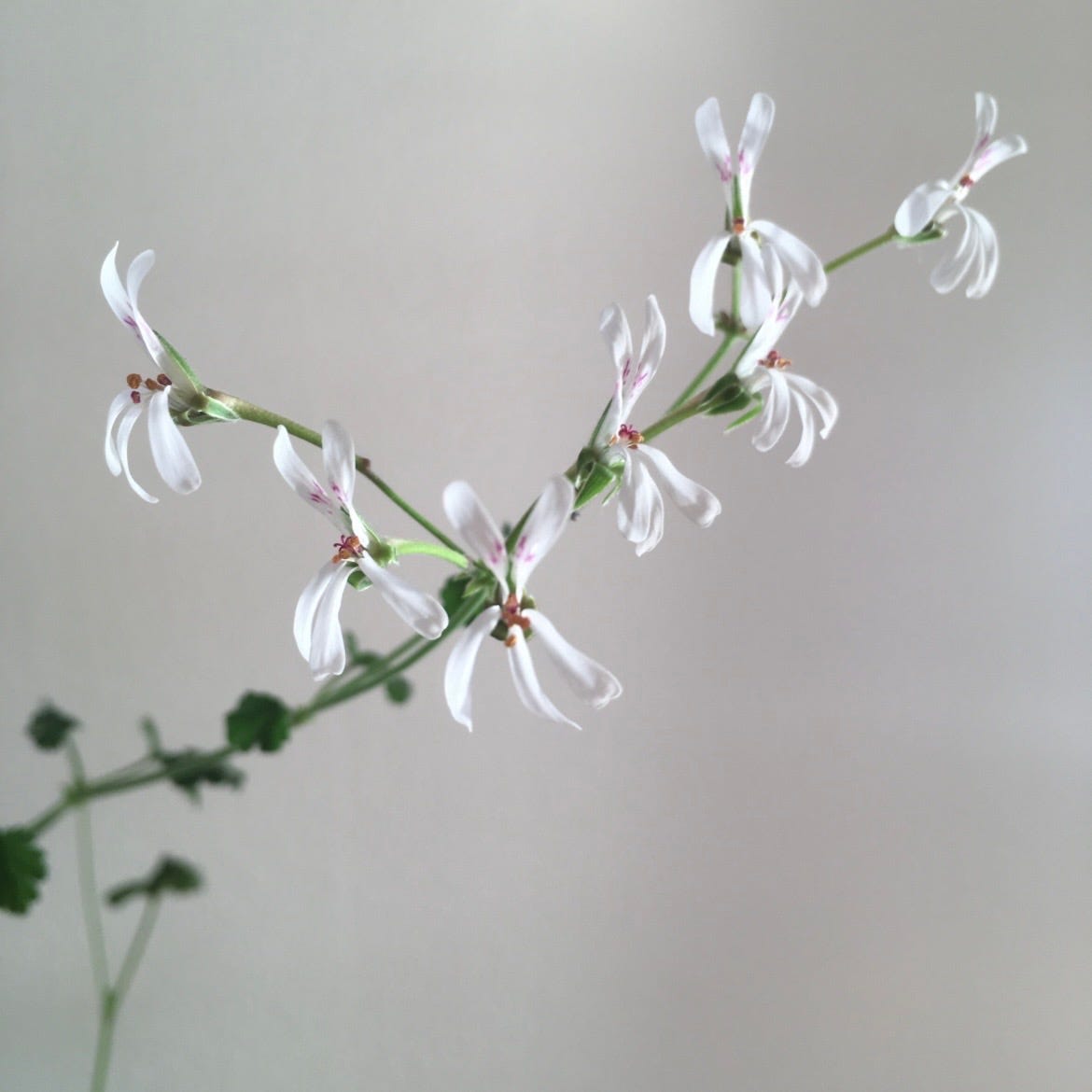
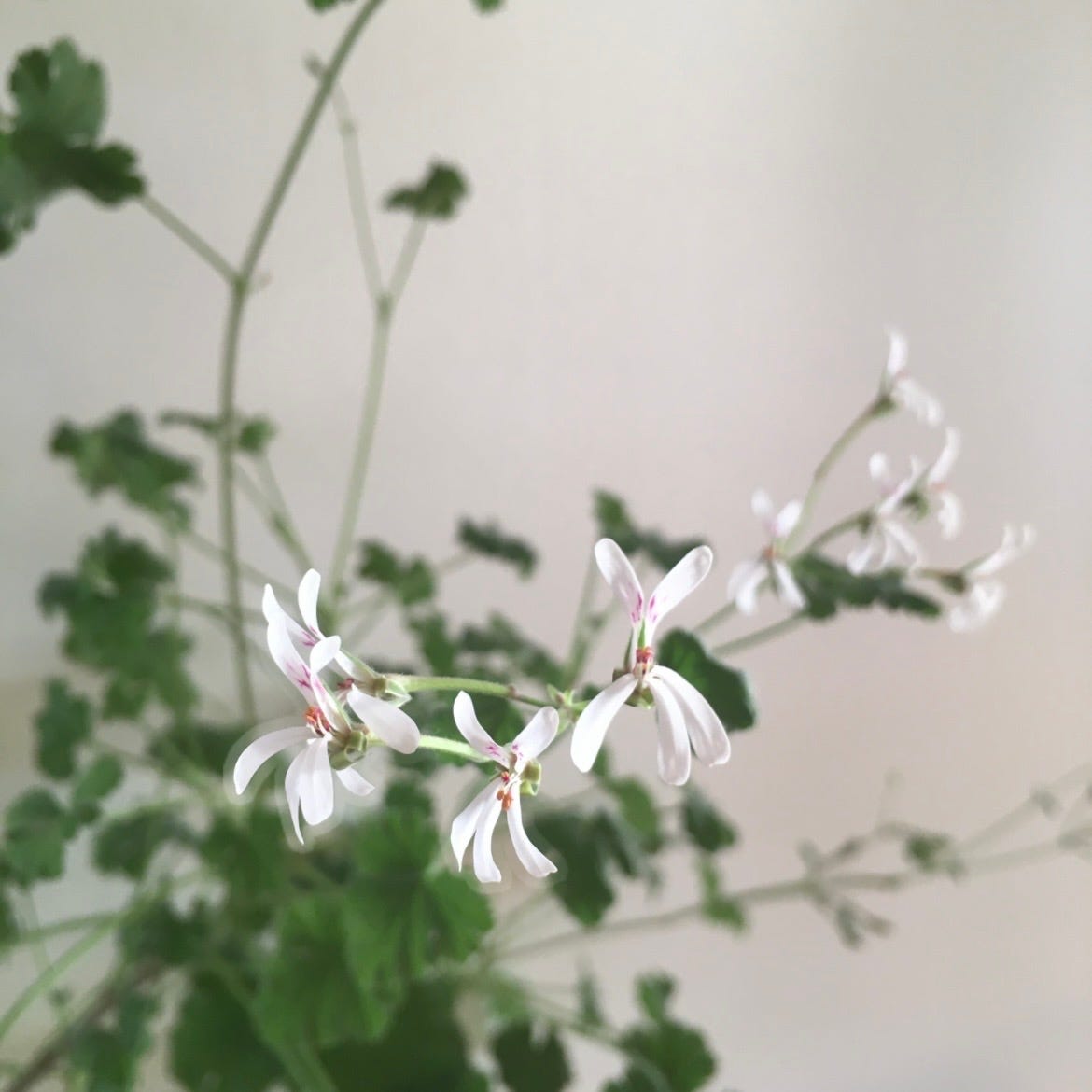
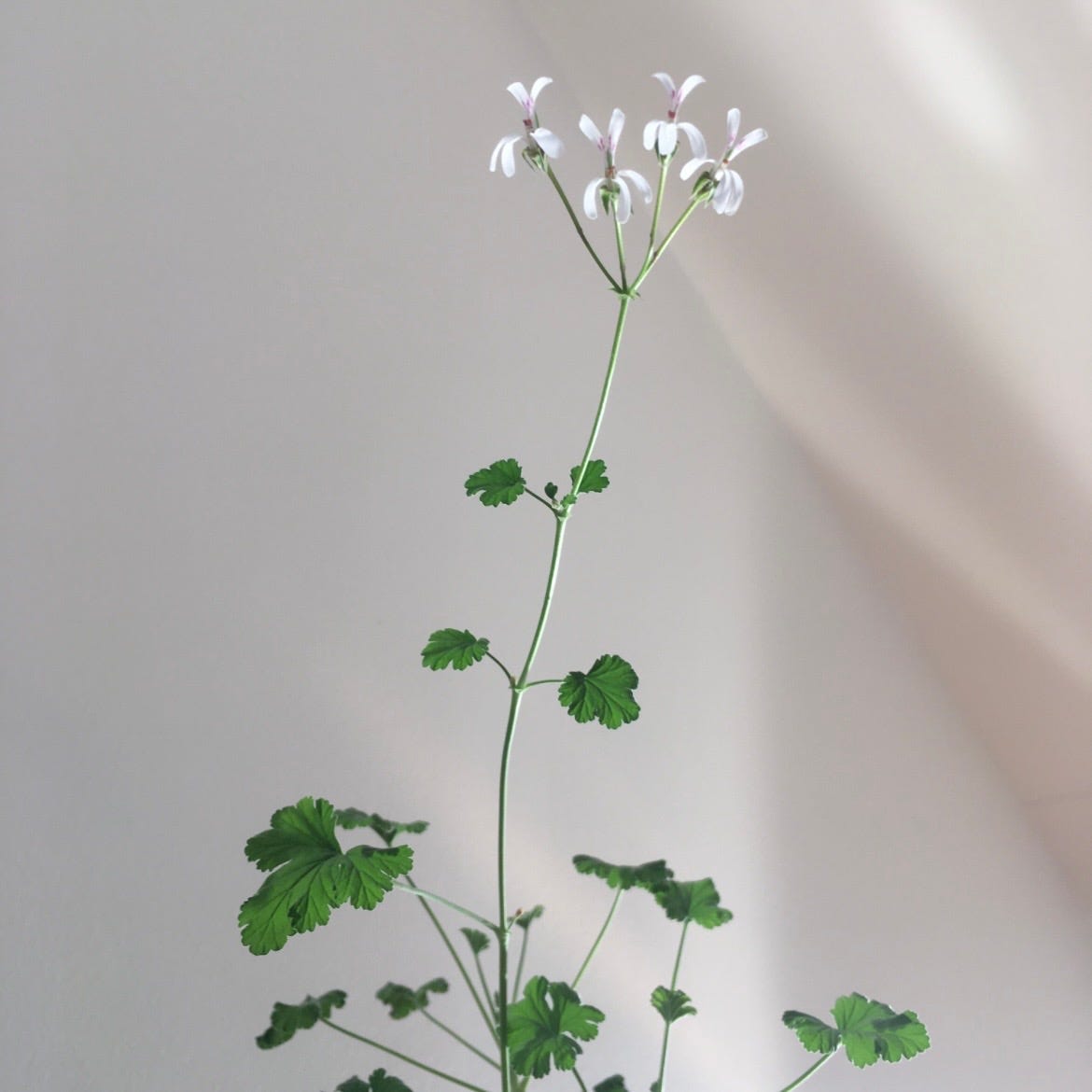
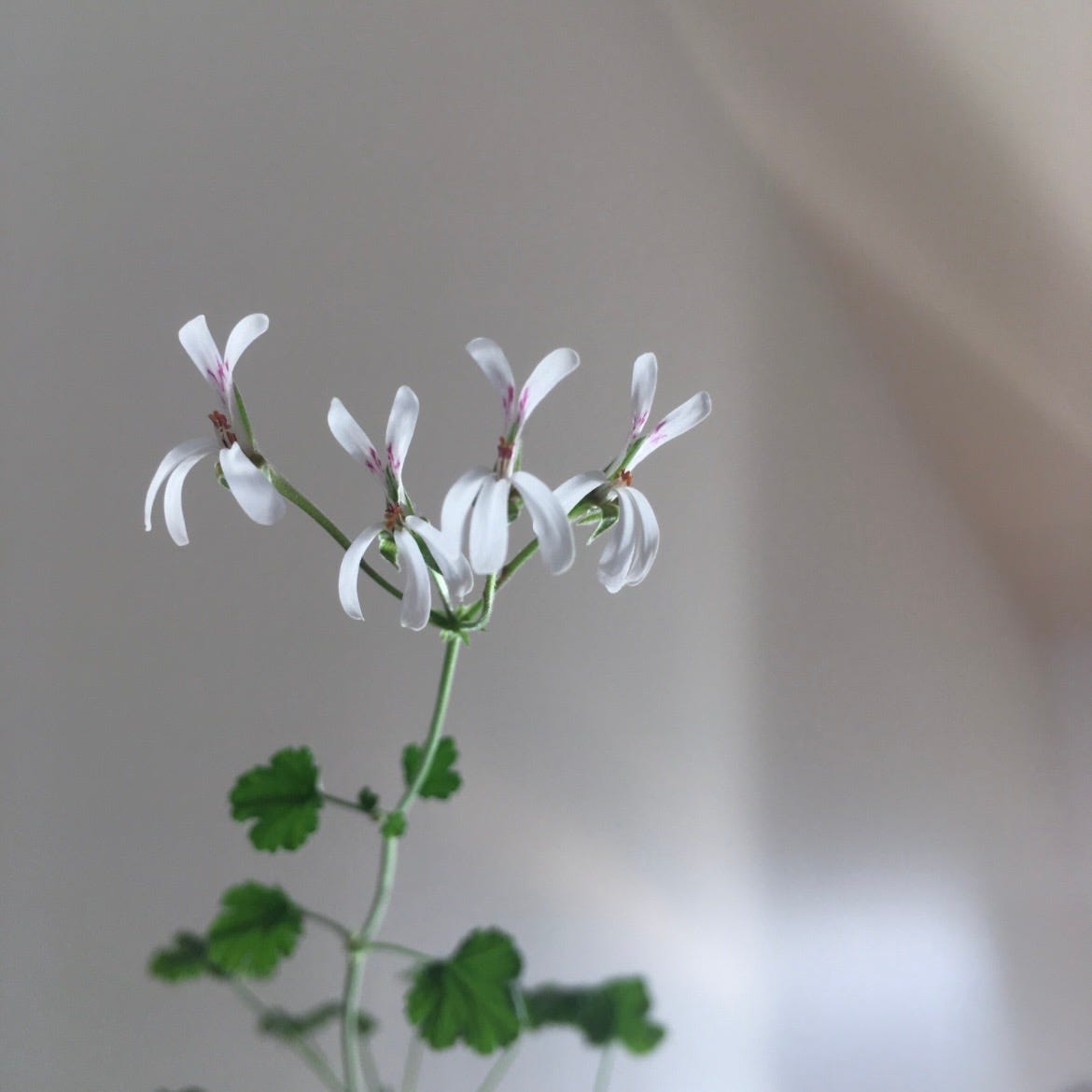
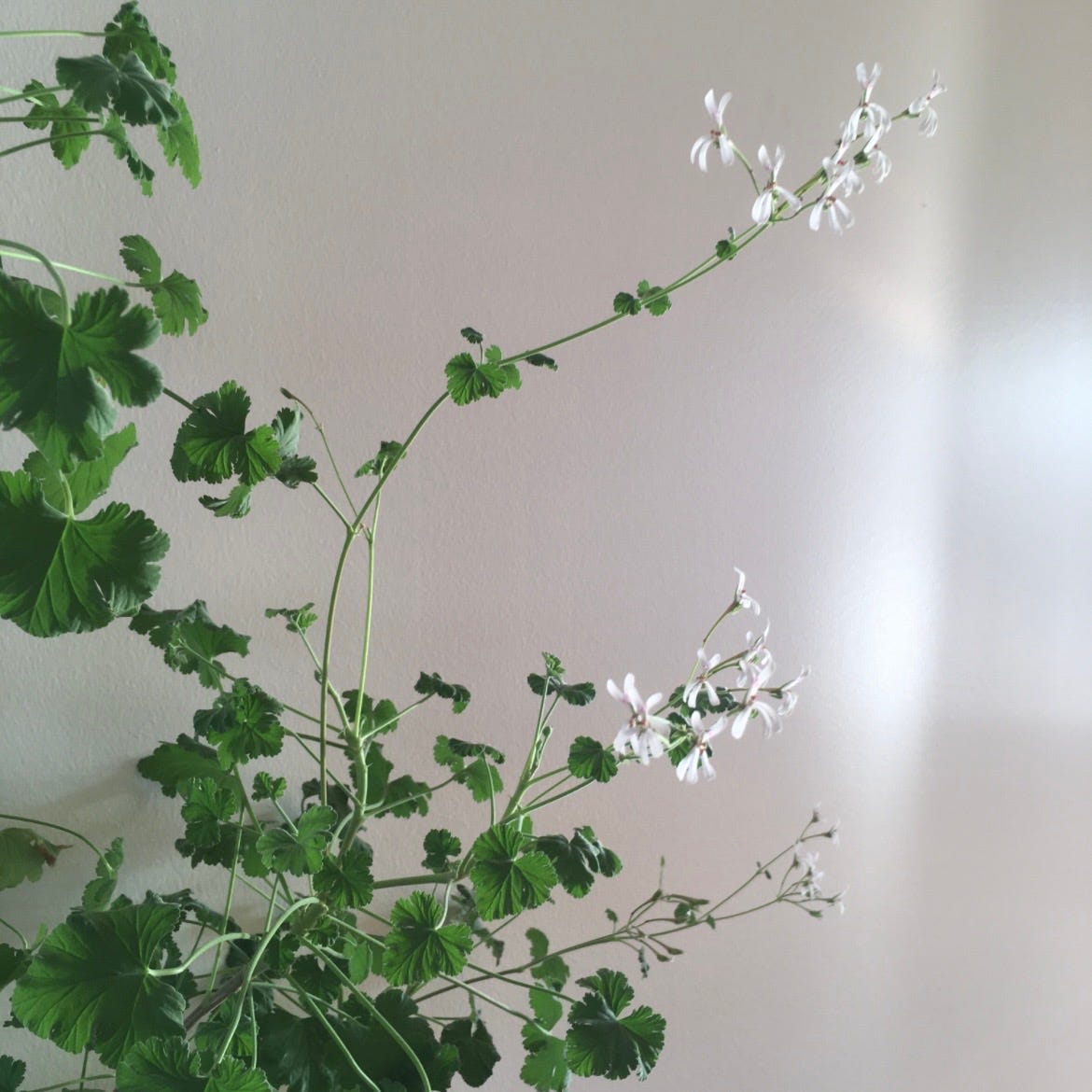
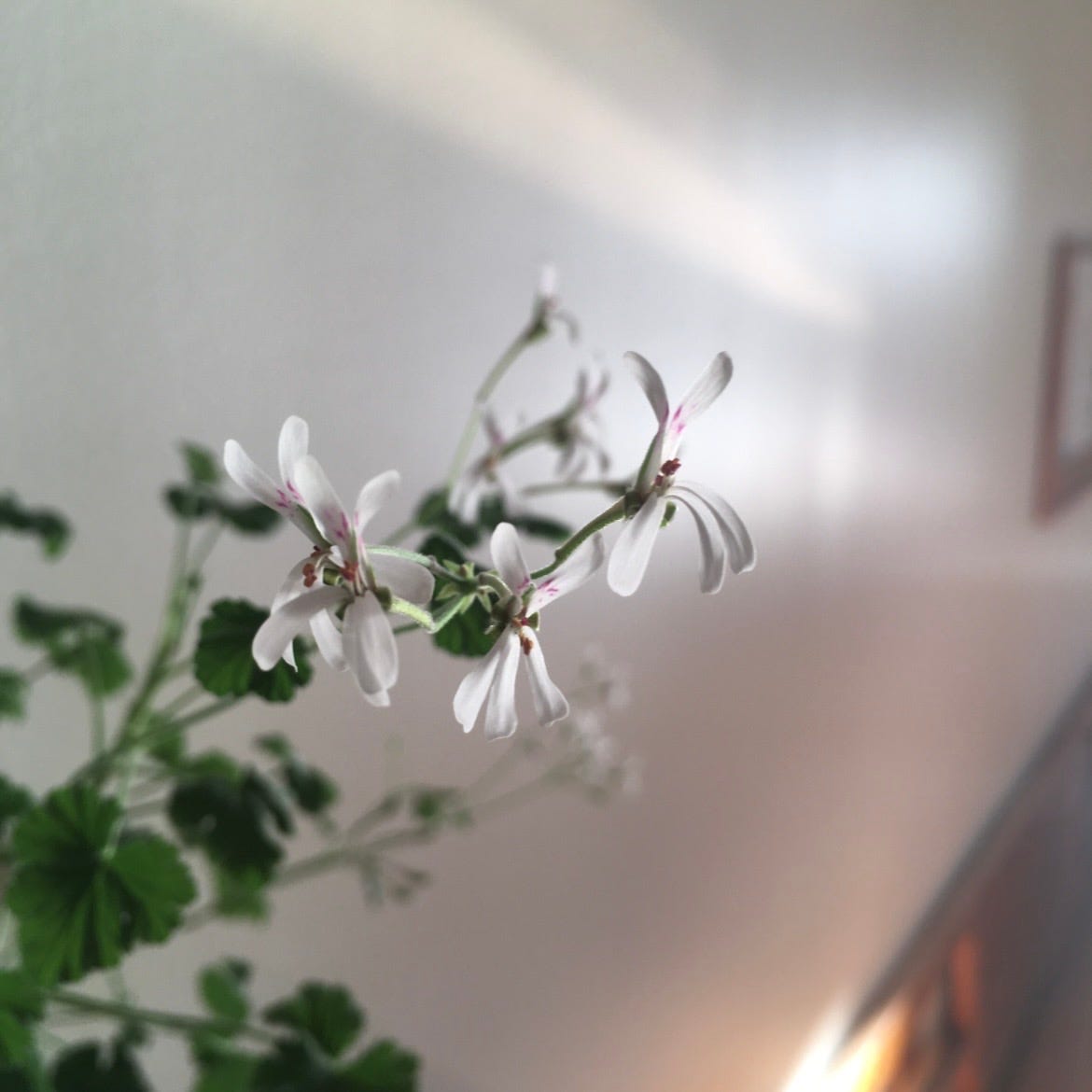
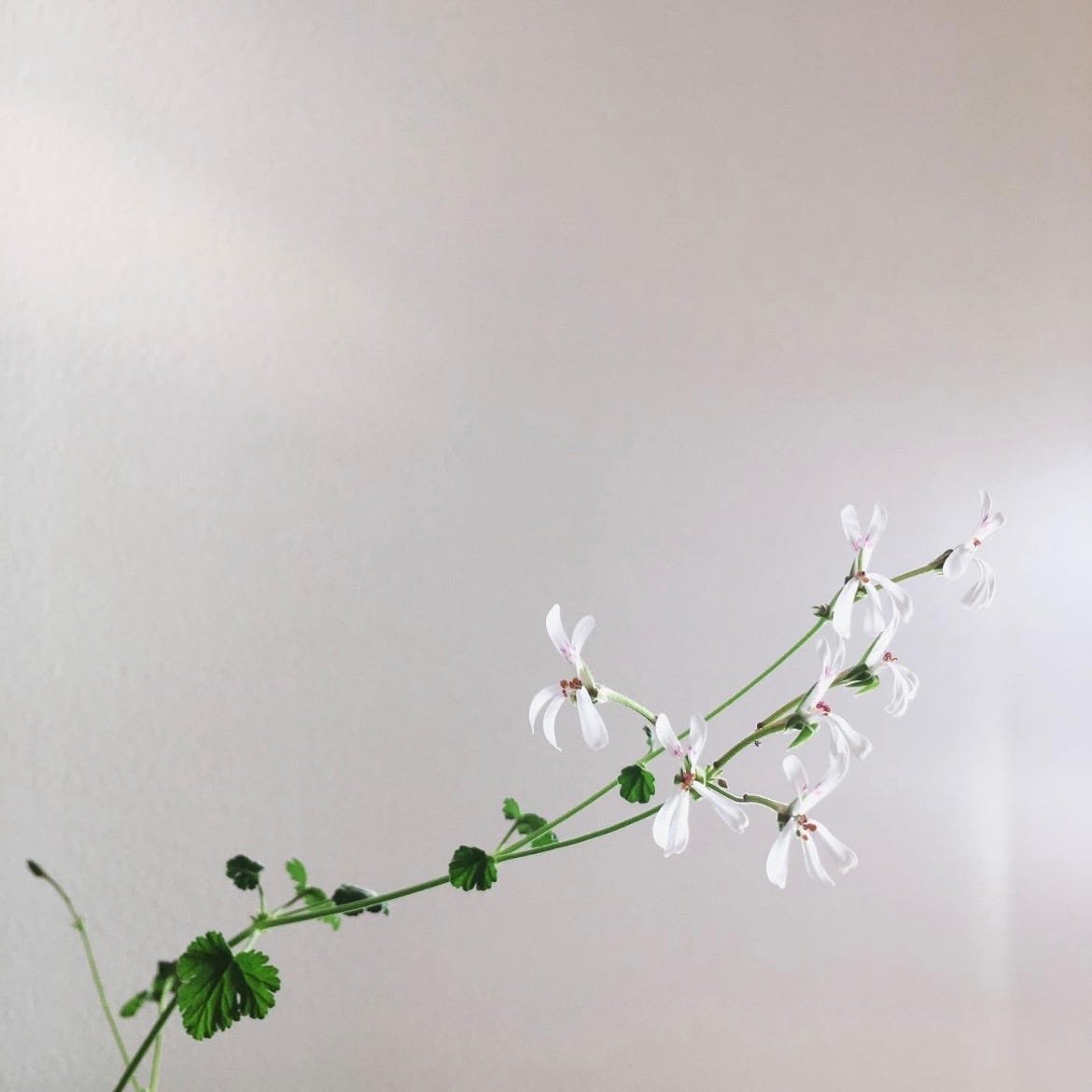
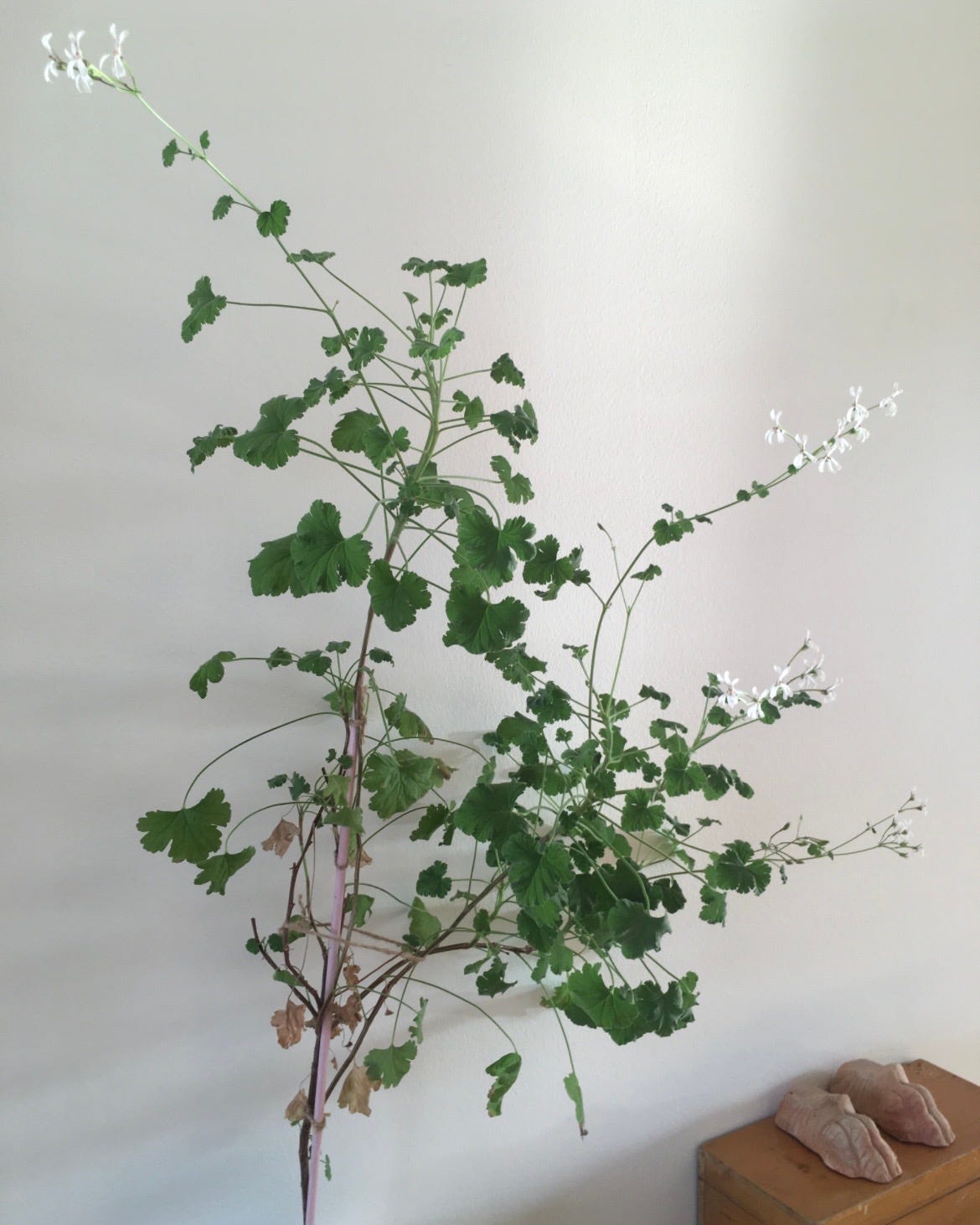
A geranium, perhaps?
A plant that once grew wild, and still does, in South Africa, then spread across botanical gardens, and at the hands of botanists, grew larger flowers, and developed precious scents. Then became a common hand-me-down, an ordinary houseplant. Red, on the balconies of Teheran, and Istanbul. A tiny white heart in the villages of Ukraine. Pink blossoms waiting on the veranda, here in Sweden. Or, as is the tradition in Swedish cities, pink blossoms in the stairwells of apartment buildings.
No one minds if you nick a few cuttings.
No one buys geraniums in shops.
Someone made the initial investment.
But who knows who started it?
If one plant costs a dollar, or a pound, then just imagine the price of the sheer hospitality of geraniums across the globe.
Wherever you go, there they are, always blooming.
This is also politics.
One day you pick one for yourself, and place it in a glass of water as you go.
Care says: hello.
4. Simplicity shapes the world.
Outside of will, the world moves differently. Water flows, and rocks tumble, according to the laws of physics. The path of least resistance is always taken. Nature wastes no energy, and no time. All things go, as they must go. From A to B. From this to that. Without detour, and without hesitation. If not, the science of physics could not exist in the first place. But it does, and this is what physics is.
The convenience of the universe.
Simplicity, indeed.
Life is surprising in its complexity.
Care is therefore difficult. If you think about it from the perspective of a universe following the path of entropy, and nothing else, why care? But we know that is not the case.
Life itself is something else.
From a certain point of view, care is resistance.
To make life easy demands a lot of care.
To not just die from random circumstances demands at least a modicum.
Ah, but someone might always say –
I’m tired of society! I’m tired of politics!
I’ll survive alone in the wilderness!
But the wilderness is just another system.
Just like the city.
It’s highly complex, full of life, and you won’t be alone out there.
But suit yourself! – I might reply, because I’m tired of not-politics. You’ll come home when you’re hungry.
Politics is just another word for relationships, and there is no place outside of relationships.
‘The economy’ is a set of relationships, and so is ‘the war’.
Not very romantic, I know.
But it could be?
5. Enough.
To endure the great carelessness, resist the mood swings, and refuse the aimless theater with no end, (which is something I think we should all want), some people simply refuse everything.
They refuse the news. They refuse social media. They even refuse to listen to other people in real life. Music is not supposed to be political. Sports are not political. Art is merely fun, and pretty.
You know what I mean.
The Eurovision Song Contest has managed to become not-political-enough to warrant its own boycott by a number of countries. A young Ukrainian athlete has been disqualified from the Olympic Games because he refused to take off his helmet, which was covered with portraits of dead Ukrainian athletes. He was asked to wear a different helmet. Commenting on the Super Bowl Halftime Show, the President of the United States claimed that nobody understood the performance because it was in Spanish. Spanish is spoken by more than 50 million people across his own country.
Not-political art is more political than political art.
Who cares about Banksy when there is an alternative All American Halftime Show?
Curling up in front of what is left of the Eurovision is a statement with no statement. Parts of the map are dark, and this will not be mentioned.
“The echo from the voices of the dead is so loud it terrifies the IOC.” says Heraskevych to the press, speaking from the Olympic Games in Italy.
In other words: what is missing is always present. Sometimes its presence is stronger than what is there.
Refusing everything invites everything.
If you think reading the news with your morning coffee is too draining, wait till you see how draining a full day of complete denial can be.
Carefully choosing when you are able to care for a few minutes, how you will do it, and what you will care about, frees you up for the rest of the day.
It frees you from attending the theater with no end, because you decide when.
It ultimately frees you from the mood swings, because you decide when, how, and what.
Instead of refusing everything, you invite yourself.
You are not very useful if you are drained.
This is a simple fact.
To care you must care for yourself.
When you do, you will find that the world is not too much, and that you are always just enough.
6. Self-care.
Self-care is how you get your power back.
So they say.
The overflow is the only place from which you can serve, from which anyone can serve. From which anything flows.
Meditation is as essential as coffee in the morning. A brisk walk is the very way the hand extends itself to meet the need. My own need is the need of the other, and the need of the other clicks neatly into the need of my own.
I forget myself in care, but I include myself, and remember.
I’m still here.
If I’m gone, then nothing extends itself.
I’m the extension.
To what do I extend myself, if not to care?
To what?
To care.
This was lovely. It says so much, in such a poetic way, that it made me smile. Pure poetry. 🙂 Thank you
Perhaps that's why I liked it so much. It helped. 🙂